No doubt about it. JJ Abrams is a genius. The guy is more well known then some actors among the general populace, and that is saying a lot for a Producer/Director in the television world.

On May 12 the first season finale of Fringe, JJ Abrams latest brain child, concluded with the kind of quality storytelling and solid cliffhangers that many have come to expect from the wildly ambiguous storyteller. Not to say that Abrams deserves all of the credit. Like any good creative Producer he surrounds himself with the kind of talent that fledgeling bloggers like myself would kill to be around. The kind of talent that brings Lost to a new level of success as it slowly (and sadly) comes to a close.
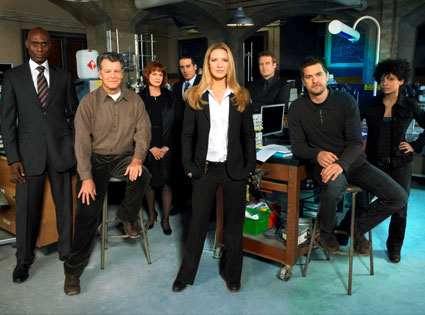
For those who are not in the know, Fringe follows an FBI agent, a mad scientist, and his well-connected son, as they investigate crimes related to "The Pattern," or a series of events that border on fringe science and x-files type paranormal happenings. The premise is simple to the point of formulaic, yet effective. FBI Agent Olivia Dunham is played rather straight by Anna Torv, and her character has remained strong throughout the season. It seems like almost every episode Agent Dunham is pulling her gun and taking shots at someone, or something; And Anna pulls it off perfectly. Joshua Jackson definitely came on to the show with "Pacey" hanging over his head, whether that was good or bad depends on your point of view. I have to admit that I really dug his character from the pilot episode, and thought our resident Canadian represented well.
Credit for the popularity of the show I believe has to go in part to John Noble, who plays the mad Dr. Walter Bishop. I picture writing sessions being put on hold so that they can get John on the phone to ask him what he thinks Bishop would say or do. John completely embodies the character and by the second episode he was clearly playing the necessary role that kept the audience well informed through all the pseudo-science in the story; But he also brought a level of comic relief that most sitcoms would love to bring to their respective tables.
 The show manages to take a rather formulaic concept and add a mythology that pushes the viewer deeper than they thought was possible. Just as Lost has clearly done.
 The difference here is that Fringe is set up to be a little more free for it's audience. Meaning that if you miss an episode you aren't necessarily.....well.....lost (can't help that one. Every time I bring up Lost as a topic of conversation someone has to pull that joke when they indicate they couldn't keep up with the show. Every time. Without fail.)
I would never lie. I willfully participated in a campaign of misinformation.
Back to the finale. The whole season has been setting up the character of William Bell, who is the founder and Mr. X behind the corporate giant Massive Dynamic. My early thoughts, which I don't consider to be sci-fi naiveté, sat firmly on the idea that Massive Dynamic would ultimately be the enemy revealed. Right from the pilot episode the corporate monger's public face Nina Sharp was playing what seemed like both sides. From trying to enlist Agent Dunham in one scene, to partaking in shadowy and secret projects the next. (Shadowy?)
Who knew that in the final moments the mastermind that was discussed throughout the season would show his face and be........Spock?!? Both my wife and I looked at each other during the opening credits of the final episode and thought "Leonard Nimoy?"
So I'll quickly run down a list of observations that stick out in my mind now that the finale is over and the show is set to move on with it's mythology. Down the rabbit hole.
There is more than one of everything
You can't help but look at the obvious when it comes to episode titles. Throughout this final season David Robert Jones is trying to open a "window" into an alternate reality in order to cross over. His intentions are foggy at best, though it is clearly stated by Nina Sharp that he is after William Bell, who has managed to cross over into the alternate reality and remain there for some time. The question is, has William Bell managed to bridge the two realities so he can cross whenever he wants? Agent Dunham's elevator ride at the end of the episode seems to imply so.
The Observer hands Walter Bishop a coin and uses the line "There is more than one of everything," right before asking the mad scientist to enter his old beach house and search for something that he hid there many years ago. The coin is exactly like a coin Walter used to have, but it is not the coin. This something that Dr. Bishop is searching for ends up being some kind of device, just like Jones', in which he can open a window into an alternate reality. The difference being that Walter also built a plug, in order to close said window in case something from the other side has intentions of coming through.
During this whole scene Walter tells Peter that he once lost something he was very fond of, so he built the device to cross over to another reality in order to get the duplicate of the thing he had lost. Soon after we see Dr. Bishop back at a graveyard where he tears up, and places a coin, Peter's coin as it was revealed, on a gravestone. The camera pans down and we see what Dr.  Walter Bishop lost some time ago. The stone reads "Peter Bishop 1978 - 1985." So is Peter Bishop really from the alternate reality? If so, this would partly explain why Peter was able to get better on his own when it was revealed in "Safe" (10th episode) that he had a rare disease similar to Hepia, which apparently is a form of bird flu. It also helps to explain why Peter has been having so much trouble remembering anything about his childhood. I love that the writer's have a larger picture in mind as they write these characters. Seriously, the writer's of Heroes need to start paying attention to what obviously works, and what really doesn't work.
Walter Bishop lost some time ago. The stone reads "Peter Bishop 1978 - 1985." So is Peter Bishop really from the alternate reality? If so, this would partly explain why Peter was able to get better on his own when it was revealed in "Safe" (10th episode) that he had a rare disease similar to Hepia, which apparently is a form of bird flu. It also helps to explain why Peter has been having so much trouble remembering anything about his childhood. I love that the writer's have a larger picture in mind as they write these characters. Seriously, the writer's of Heroes need to start paying attention to what obviously works, and what really doesn't work. Back to our friend Spock, in the final moments of the episode Agent Dunham has two questions for her host. "Where am I?," and "Who are you?," both of which lead to a stunning reveal that the newspaper shown as she enters his office only hints at. William tells her that the answer to her first question is complicated, and as he tells her his name Olivia steps to the office window and looks out at the New York Skyline. Her face visibly looks perplexed as the camera pulls back to show her viewpoint is from inside the still standing World Trade Center.
I have many questions and pretty much no theories considering the nature of William Bell. Is he the enemy that Abrams talked about here? Dr. Bishop and Nina Sharp have both defended Bell, claiming that he is not the enemy. Why is he living in the alternate reality? It can not be to simply hide from Jones. Did Bell write the ZFT manuscript?, or was it Bishop and he just can't remember?
No matter what the questions are though, we know that the answers will not necessarily be the most obvious, or the most convoluted. Nor will they be coming anytime soon, as we have many more seasons of this show to go I'm sure. Abrams has not mis-fired yet, why would he start now?
*quotes in bold from X-Files

No comments:
Post a Comment